On the Road, Preparing, South America, Tourist, Traveling

How to Find an Adventure, Part I

Step one: Follow the advice of travelers you know peripherally, who don’t need to shower more than once a week, think sleeping in the same room with six other people is heaven, find patchouli to be a remarkably endearing scent, and may or may not want to get you into an entertaining mess.

Step two: Do not solicit advice from other, more similarly minded travelers, for whom sleeping without the hair of strangers left behind on sheets and blankets may be a priority.

Step three: go to a very much still developing country, find the least populated part of it, and hop on a tour.

Back up. Step two B: land in the highest airport in the world, spend three days taking Diamox and sucking on diesel and too little oxygen.

I believe I have mentioned this blog should have been called, “flyingbytheseatofmypants.com,” so it will not surprise you that these are the steps my shall-remain-nameless (totally fantastic) Travel Companion and I followed in planning our trip to Bolivia, whose primary purpose was to go on a salar tour. What, you ask, is that? I had the same question.

It turns out much of Southwest Bolivia used to be a great salt lake surrounded by volcanoes. Times have changed, but salt has not.  Over 4,000 square miles of the area is still a great salt field, worked manually by salineros who shovel the salt into piles, let the water (still not far below the surface of the ground) drain, then collect it in a truck and take it to be harvested and packaged for sale in Bolivia, and beyond.  A few meters below the salt lies the largest lithium field known to man, projected to contain 50-70% of the world’s lithium stores, currently in the process of being extracted to power our electronic addictions. All of this happens at close to 12,000 ft of altitude, under some of the clearest skies you’ve ever seen. They are so clear, in fact, and the white flat beneath them is so flat, that the area is used to calibrate altimeters of some Earth observation satellites.

Before we get to the tour, Travel Companion and I have to overcome a couple of obstacles. First, there is La Paz. Here, the airport is so high, it is actually called “el Alto.” All international flights seem to arrive between 2:30 and 6:00 a.m., for reasons I can’t understand, but which lead to a disproportionate number of people finding places to sleep in the small, humble airport until they can get into their hotels, hostels or onto morning flights to other places.  Lucky me, I found a random couch outside a ‘pay by the hour’ travelers’ hotel and happily took it. I donned my eye mask and ipod, and slept in cirque-de-soleil inspired contortion until six-thirty a.m. When the airport roared to life, I changed some money, grabbed a cab, and went to meet the owner of our rental apartment.

Because sometimes I am a moron, and because I was booking my Bogota – La Paz ticket when still in the midst of a severe state of travel panic (see The Terror), despite having read Travel Companion’s reservation six times, I still booked my ticket a day too early, leaving her to fend for herself (albeit with excellent instructions) to get a cab from the airport the next morning. As a result, when she showed up, I was a day ahead of her in the ‘adjusting to altitude and diesel’ environment, having spent about ten hours watching bad American HBO movies and eating peanut butter toast the day before. I’d also adjusted to Diamox side effects, like bouncing eyeballs and tingling extremities, especially hands, which make it difficult to sign your name, or unlock the apartment door.

Such is the state we were in when we headed out onto the diesel-fueled and diesel-fumed streets of La Paz to schedule the tour, at a Lonely Planet – recommended, bilingual tour agency with which I had been corresponding via email. I had been taking this whole thing casually, but my travel companion had been doing research, and she was scaring me. Apparently, it isn’t uncommon for tour drivers to be drunk the whole time they are driving. Since we didn’t want to pay $600 each for our three day tour, our driver would also be our guide and our cook. He wouldn’t be bilingual, and blog-rumor had it he would only cook hot dogs. Also, it was likely to be cold – REALLY cold – at night and we would need sleeping bags, which we didn’t have. What if, as the nurse at the travel clinic had warned her, my travel companion got typhoid? What if we had a drunk AND irresponsible driver and ran out of gas in the middle of nowhere, where no one found us until we had our own Bolivian version of “Alive” in full swing, minus the hot soccer players?

When we found the travel agency, we asked these questions as rationally and respectfully as we could. The kind agent tolerated my continuing to speak bad Spanish with her even when she answered me in English, and reminded us it wasn’t good for them if we had a bad tour. The last time they’d had a bad driver reported was in 2008. She recommended we bring some snacks and extra water, assured us we could rent sleeping bags from the agency, and booked our plane tickets to Uyuni for us. (We may not be willing to pay $600 for a better room, a bilingual guide or a cook, but we sure as shit weren’t taking an overnight bus to arrive the morning of our tour.)

Before we said goodbye, we were committed to whatever adventure we had just paid for, which would start with a 6:30 a.m. flight the next day. Unless the travel agent called to let us know it had been moved up to 5:30. In which case, we were pretty sure we weren’t going anyplace. We went to the grocery for bread and water, and returned home to our apartment for peanut butter toast.

On the Road, South America, Tourist

Cementerio de Trenes

There are really only two reasons to go to Uyuni: because you are sent there to work for a mine, or because you are touring the Salar and associated sights (see pictures here) and this is your jumping off point. It’s a shock to the system to land there unprepared. Sand is everywhere. A wind blows from far away and has no intention of stopping. It’s hot and dry in the sun and cold and dry in the shade. The food is blah, the scenery is sand-beige (except for the colorful skirts and mantels of women in traditional Aymara dress), and everything is overpriced, because everyone is trapped.

But Uyuni has a saving grace: the train cemetery.

IMG_4393While I appreciate that not everyone shares my love of a good cemetery, and maybe not my untested, purely nostalgic adoration of trains (we’ll see if I get over that in Vietnam, Morocco, or Europe…), surely most of you must agree that a train cemetery is a sight behold . If for no other reason than because it is like an adult playground for the tetanus-saavy.

Depending on to whom you speak, the origin of the cemetery is different, and I don’t know who holds the truth. Lonely Planet says the rusty, lopsided, off-track steam engines and boxcars date back to the 18th century, when there was a steam car factory in Uyuni. Wikipedia notes the name of the town itself, which wasn’t founded until the late 19th century, means, ‘the one with the pen/cemetery,” and holds to the more likely explanation for the train junkyard: Uyuni served as a distribution center for trains carrying minerals from Bolivia to the coast, starting in the late 1880s and collapsing suddenly in the 1940s due to mineral depletion.  Train cars and their engines, no longer used and suffering from exposure to, among other things, the massive amount of salt that is still harvested locally, were pulled away from the town to rot in this glorious, colorful, ghostly pile.

I had planned on walking out to the cementerio in the late afternoon, but quickly realized that, other than about four main routes in town covered in cobblestone, the rest of the roads – and I use that term loosely – in Uyuni are unpaved sand trails. Sometimes, they are nothing more than tire-worn ruts in the desert. It was completely unclear to me which way I should go, so I grabbed a cab and asked it to take me there and wait fifteen minutes, while I explored.

image

Needless to say, I feel instantly in love. I had the place to myself, and late afternoon light added to the eerie beauty of this bizarre hallmark of a history potentially repeating. Uyuni is the closest city to one of the largest lithium fields on earth, which is actively being mined to charge our cell phones, cameras, and computers. It may only be a matter of time before trains are once again pulling minerals to the coast.

My cab driver thought I was a bit nuts for liking this. He doesn’t understand why tourists, many of whom showed up on their way back from Salar tours while I was still exploring, would want to see ‘junk.’ I don’t know if I explained it to him in any rational way. I told him in the US, we can’t do this; we are prevented by fences and wires and alarms. And fear. But as the days of our tour went on, I realized part of it is that as people, we just like to climb on things, and as adults, we do it far too seldom.

If traveling by train is more your style than climbing on one, you can still hop on board and make it as far as Oruro, or head toward Chile. But the truth is, wherever you take the train from here, you are likely to need to follow up with a bus or a plane, so I stuck to playing around these great spirits of a former life.

IMG_5517

Moving, On the Road, Preparing, Traveling

Where and When

Friends, and total strangers….

I’ve had a couple requests for my schedule, and since I’m currently more interested in whether penguins are hatching in Patagonia than how to figure out the calendar feature on WordPress, I’m hoping you all can settle for the little list of places and dates below. It’s a rough outline; as I may have mentioned lately, I realize I probably should have titled this blog, “FlyingBytheSeatofMyPants.com.”

Through November 25th:                  Chile

November 29-December 14:           Myanmar

December 14-December 22:           Cambodia

December 22-January 2:                  Vietnam

January 2 – January 5:                     Thailand (does anyone else see a problem with my ‘New Year’s on a Thai beach’ plan?)

January 6 – January 12:                   Jordan

January 13 – January 26:                 Kenya

January 31 – February 12:               Morocco

February 13 – February 20:             Spain

February 21 – March 1:                    France and Switzerland (Geneva)

March 1 – March 7:                           Amsterdam

March 8 – March 14:                         Eastern Europe TBD

March 15 – April 5:                            Turkey

Looking at it now is pure insanity and I already know how much I’ll miss the things I don’t get to because of time. It’s also pure excitement to see on a page all the amazing places I will get to experience before flying back into DFW, six months and one week to the hour after I flew in for my pre-departure visit. I will be jet lagged and travel weary and hopefully wiser and definitely ready for a Manhattan on the Tried and True patio so someone hook that up!

On the Road, Tourist, Traveling, Uncategorized, United States

Heaven on Earth

I’ve been thinking about heaven a lot lately, driving around the United States and finding myself fully realizing the words to ‘America, the Beautiful,’ as amber waves of grain roll by my car windows. I’ve fallen into describing the awe-inspiring landscape as “heavenly,” meaning it brings peace, visual pleasure, and possibility into my frame of visual reference, and thought. In hotels, I’ve slept on more than one ‘heavenly bed,’ some because they are branded that way, and others because they bring the possibility of sleep and the chance to unbend my frame from it’s too-frequently seated position.  And from airplanes, of course, I’ve looked down at an ocean of puffy white cotton-like clouds outside the window and thought, ‘this is what they say heaven looks like.’ Yet upon my return to Orcas (the island I’ve made home base this fall) after a few weeks away, it occurred to me that if there is a heaven on earth, it is not a place or a vision, but a smell.

Sometimes heaven smells like wet seaweed

Sometimes heaven smells like wet seaweed

Smell transcends time and place. It can carry you from where you are now to where you were when. Think about it: the smell of fresh-baked cookies – anywhere – in a home or a bakery or wafting down a street in any small town or large metropolis – any where  in the world, can pull you from the moment you are in, to another moment, possibly long ago and far away, that is anchored by the smell of warm chocolate chips and dough that sinks back to hug them as they cool on a rack, and defined by the moment of peace or hope that it brought to you back in that time and space. Isn’t that what heaven is? The transcendence of the present to a larger realm of peace and possibility?

Sometimes heaven smells like fall

Sometimes heaven smells like fall

I am a person of place. I always have been.  I engage in a place by falling in love with its landscape. When I lived on the east coast, I often longed for the west coast with its cold ocean and high foothills. I longed for the hilly streets and old Victorians of San Francisco. I longed for the stillness of this island on which I’ve spent much of the last two months, and for the serenity of the view from where I now sit – over the grass, beyond the apple trees to the sound, to Lopez Island, to the sky above it and the Olympic mountains standing guard behind. For most of my life, I have associated this anchoring, this peace, with this place. I believed, for much of  my time living in Dallas, that what made it difficult was that city had no hills, not enough trees, too much strip mall cement.

And then a week ago, I drove off the ferry, cracked my window, and was in my heavenly home. The smell of clean air, laced with sea salt and rained grass, rushed in to welcome me.  In the distance was a top-note of wood-stove burning off fall chill and deep, deep beneath it were undertones reminiscent of the sun warming sugar out of last summer’s blackberries.

Suddenly, all the smells came to me. It wasn’t San Francisco I missed when I was on the East Coast. It was the smell of old book stores filled with history and revolution. It was salt floating on fog on early mornings when I waited for the bus to work. It was eucalyptus  trees carrying their native Australia to Tennessee Valley. Strip malls weren’t the problem with Dallas. The air was. Except when it was raining, and the air was filled with the electricity of a storm, Dallas atmosphere stagnated. There was no news being brought on the wind. You couldn’t tell where the ocean was by inhaling. There was no possibility blowing through.

And so, as I prepare to leave for lands that smell of dewy mornings in thin air, of the dirt road beneath your feet, the slow burn of trash in a neighboring field, the diesel of combis and collectivos that roar by, I’m taking some time to absorb this heaven. Lying in bed last night with a rain pounding wind down through the alder and rushing the scent of leaves and water through the roof eaves to where I lay, I inhaled deeply and held my breath, absorbing just a little bit of heaven on earth to bring with me on the road.

Heaven is the smell of true north

Heaven is the smell of true north

On the Road, Tourist, Traveling, Uncategorized, United States

Wild. Wonderful. Wyoming

I’m a sucker for a diorama. Always have been. Maybe it was those sugar eggs we got at Easter with the little scenes inside, or an over-eager grade school homework project  that did it, I don’t know. Maybe I just like how life looks, all laid out for view in a tidy defined box. Whatever it is, it’s stuck with me. So when I pulled into the Southeast Welcome Center on I-25 outside Cheyenne, Wyoming and perused the brochures to see what might be found in Casper, where I was headed for the night, it is no surprise that the flyer for the Fort Caspar History Museum caught my eye.  And it didn’t disappoint.

Captain's letter awaits an envelope

Captain’s letter awaits an envelope

The museum is on the site of Fort Caspar, and the remaining buildings – officer’s quarters, the mess, the store and stables – have been restored and stocked and they sit away from the main museum site, so when you stand there, wind blowing up from the Platte, sun bearing down on an early fall day, squash ripening in the fort garden, you can *almost* sense what came before you, quiet, isolated. Blue coats, sabers, and captain’s hats adorn the bunks, checker and card games are laid out on communal tables next to tin mugs, ready for rowdy players and beer. A telegraph machine waits for news on a table in its own cabin. Off to the side, a Mormon Ferry buggy stands proud. Diorama, real-size.

Soldiers quarters in the mess

Soldiers quarters in the mess

Telegraph table.

Telegraph table

Inside the museum, the history of Wyoming has been lovingly recreated in one diorama after another. A display of stone tools through different eras of history outlines changes in the land and the people, new kinds of stone, new types of tools, arrival of Europeans. Around it, in wood and clay, miniature native Americans hunt mammoth, hunt buffalo, build teepees, fend off Europeans, and then attack them. Men and horses fall in gory fashion, red-painted blood oozing from their detailed clay bodies. It’s miniature America in all her glory.

Miniature America, in all her glory

Miniature America, in all her glory

Wyoming is full of little treasures like this: pieces of history that have been picked up, cleaned off, embellished and put on display. I skipped three other museums in Casper in favor of getting back on the road to Bozeman, and didn’t even touch on others that are sprinkled along drivable routes across the state. Maybe it’s the benefit of oil dollars, though neither Fort Caspar nor the Welcome Center itself (which had a historical display, including a dinosaur skeleton and a number of dioramas) glossed over the boom and bust effect of the industry, that fund all these little gems.

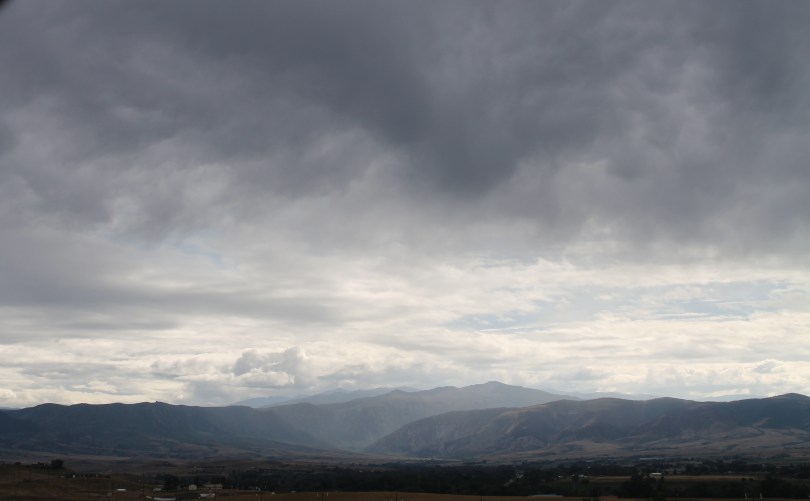
And what would be the point in hiding this ugly truth? You can see it in the life-sized diorama of scenery that is Wyoming itself as the land goes by. Towns like Story, Buffalo, and Bar Nunn pulling you off into the distance of gas-scarred hillsides. Mule deer and cattle graze side by side on rolling grass-spotted hills and mesas, hiding between rock skyscrapers, divided by snow fences, waiting for winter.

Wyoming rolling by

Wyoming rolling by

You feel the state in your bones as you drive it: riverbeds of cottonwoods changing colors and hardly another tree in sight except on the distant jagged mountains.  Red rock, granite, trains winding through. The Crazy Woman river running across it, running through you as you drive by. Wyoming. Wild. Windy. Wonderful Wyoming.

Sun after the rain on I-25

Sun after the rain on I-25

Wild. Wonderful. Wyoming.

Wild. Wonderful. Wyoming.