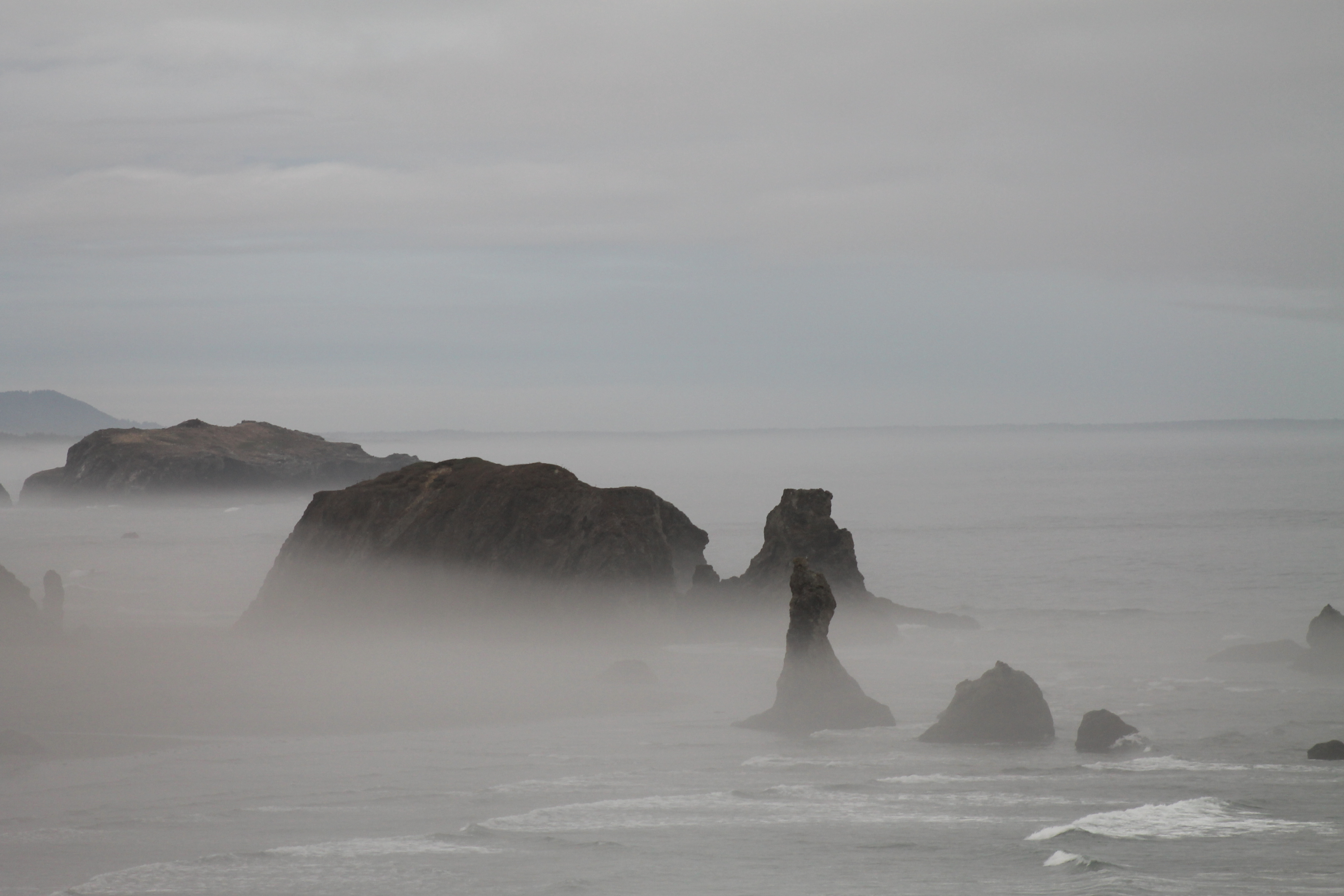
Sea Stacks in Bandon
I’m chasing my ancestors down the path of their history, backwards through the towns they settled along highway 42 in Oregon. The route wraps around the south side of the Coquille river, starting with the warm fog that twists its way around sea stacks in Bandon and heads into Pleasant Valley, where the sun blinks through overcast skies.
My goal is to visit the graves of my grandmother and her family before tearing north on I-5 to make the 9 pm ferry for the San Juan Islands. But a 20-year absence from this part of the country and a couple well-placed questions from my mother have got me reinventing that kids book I used to read in kindergarten, “Are You My Mother?” Instead of a bird asking every living animal or machine if I belong to it, I’m a human screeching off the highway every time I see a sign for a cemetery.
“Are YOU my cemetery,” I asked this morning, after taking a hard left and tiptoeing through the remains of Coquille, to arrive at the Masonic Cemetery. Coquille’s main street looks like a movie set – a stately bank, sculpted storefronts, and too many empty windows in front of which few people move. The cemetery is so small and non-descript I couldn’t believe the Masons claim it. I u-turned illegally in front of the high school marquee announcing registration dates and head back to 42, conspicuous in my dirty black foreign wagon with the Texas plates.
“Are YOU my cemetery,” I asked again, outside Coquille, when a cemetery sign pointed up a small hill to the Myrtle Crest Memorial Gardens. The hill and quiet atmosphere were promising, but the cemetery was new and compact, one small loop of road with grave markers on either side, and four groundsmen tending to the sprinkler system. One moved his truck out of the one lane so I could get by without running over the dead, and while I headed back down the hill I thought it must be true what they say: the only two things you can count on are death and taxes, and the death part is an increasing certainty in this part of the country, where the land is what you count on, and there isn’t much else.

View of Pleasant Valley from Norway Cemetery
In my memory, at least, MY cemetery sits high on a hill with a view of the valley and a two lane road winding beneath it. There are pine trees, and graves from the last century, and an A&W not far down the road. I remember thinking the last time I was here that this wouldn’t be such a bad place to spend eternity. But things have changed. The winding two lane road is now a six lane arterial, and the town of Norway, which I believe is where MY cemetery is located, doesn’t show up on my iphone map. Still, the road winds on. To the left, hills rise and fall, and to the right, the valley lies down, throwing up a lumber mill, new or abandoned, or a dairy farm, from time to time.
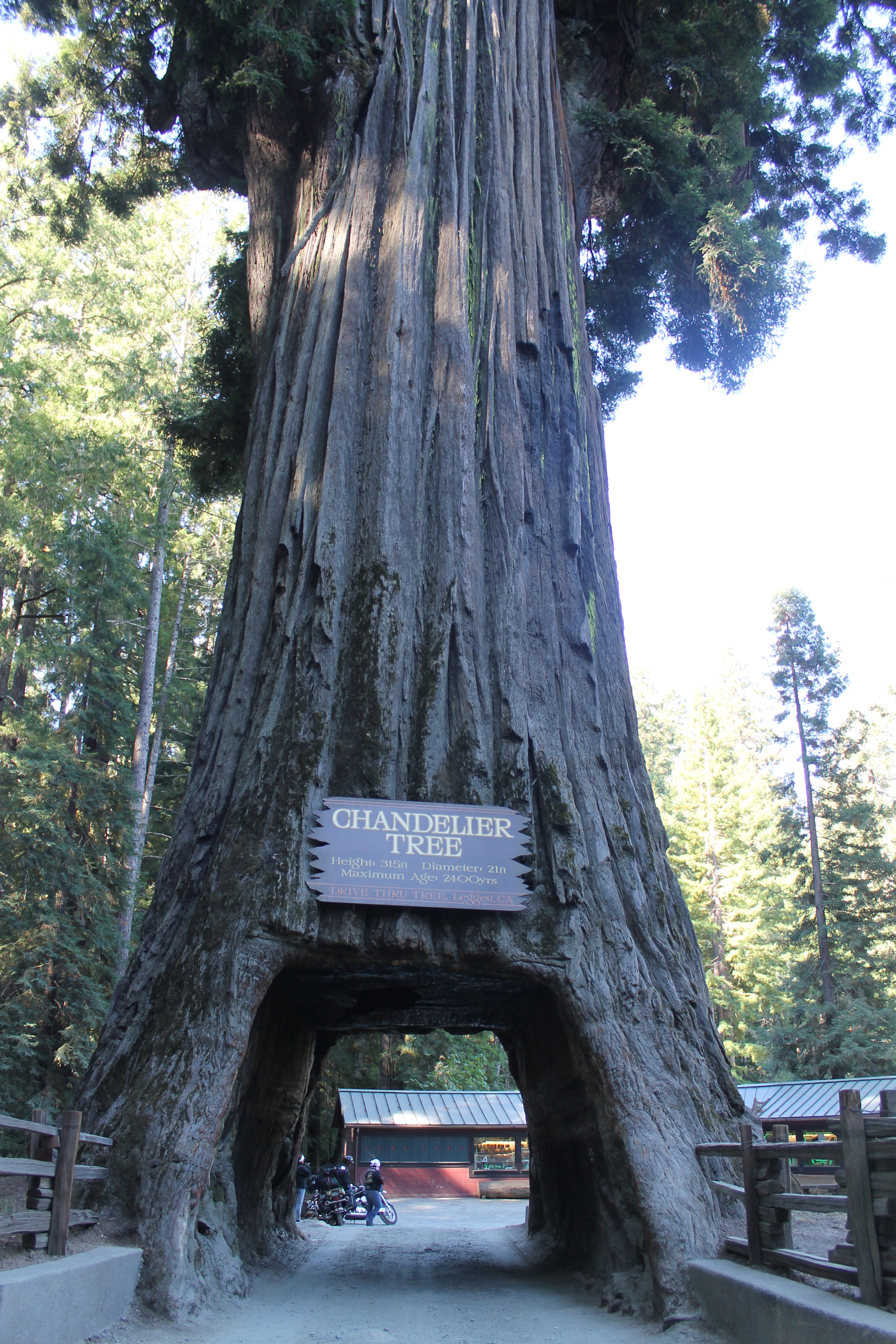
The Chandlier Drive-Thru Tree
They know what they are doing here, and they’ve been doing it for more than a century. Sheep and cattle graze the flat lands, timber is cultivated and felled on the mountains, and milled beside the busier transport roads. Always, trees are left bundled and tall along the most visible pathways, as if the pine curtain can hide a naked mountain of clear cut, or the low bush where trees begin to grow back, only to be cut again in how many years? 40? 50? Nothing will replace those that came down a century ago – like the ones along the Avenue of the Giants I drove yesterday on my way up California. There are no more “Drive Thru Trees” being grown, no more “One Log House.”

Mechanical memories of yesteryear
While I am gaping yet again at a truck cab speeding past, hauling his own back half on his mid section, the empty hitch and fork of a logging truck without the load, I see another cemetery sign out the corner of my right eye. As it registers, the turn-off passes on the left, blurred by the roadside leftovers dancing in the wake of the Mac cab. I take the next opportunity to pull off the main drag and circle back on old 42, slow, narrow, littered with mechanical memories of yesteryear. This is the southern Oregon I remember. This is my America.
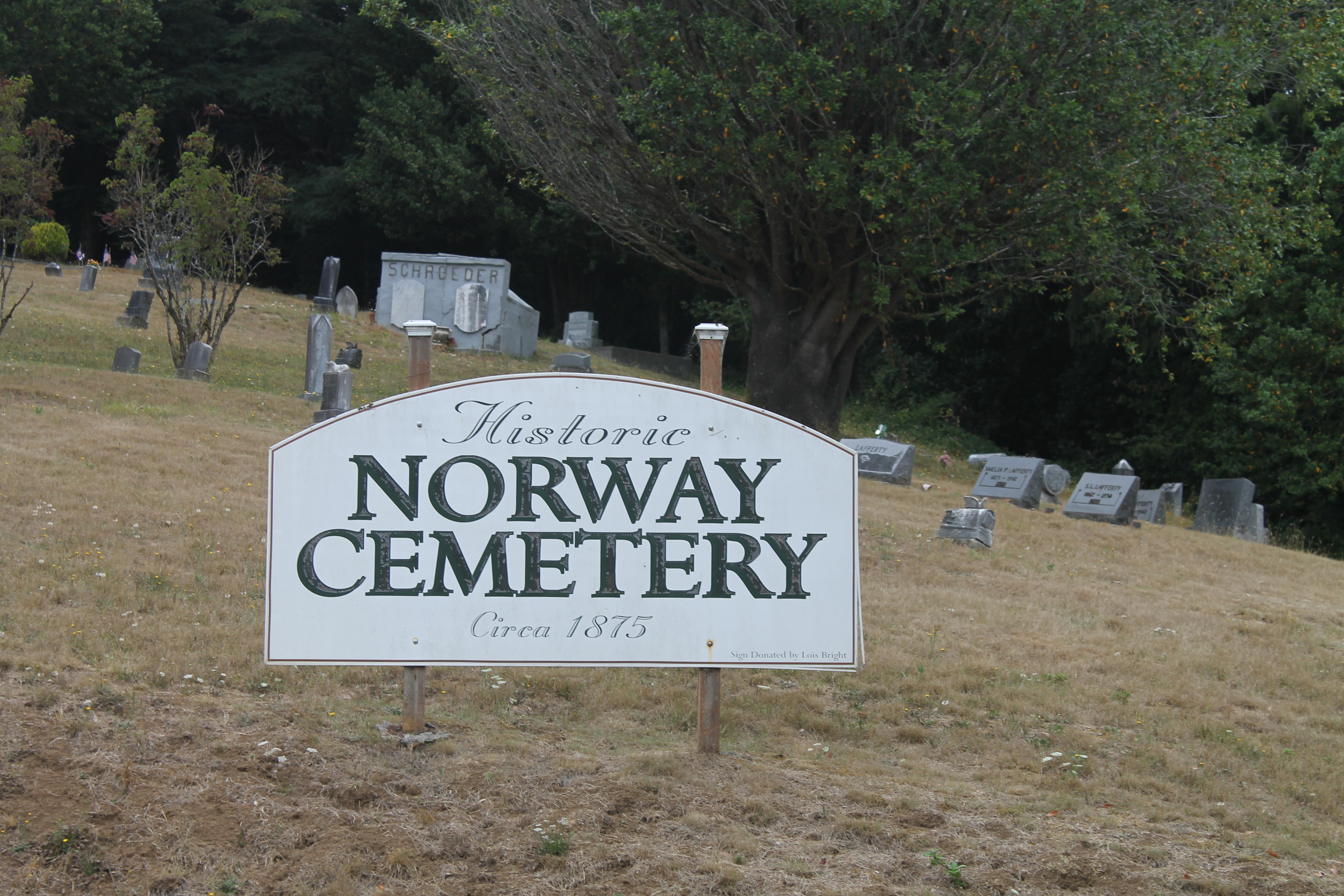
Welcome to Norway Cemetery
I miss twice before making the turn. The new road is up ten feet higher than the old one. To get up the cemetery hill, you must first go down into a rut. “Historic Norway Cemetery,” the sign welcomes. Then validates, “circa 1875.” My grandmother and great aunts, their parents and aunts and uncles are where they were left. The view is little changed, though the trees slightly overgrown. A lone gardener tends to some of the grave sites.
I sit with my family, have my communion with the dead. The dog chooses my great-great uncle’s stone as a cool place to lay his head on a heating day. I update everyone on my sisters, my niece and nephews, who looks like whom and acts like who else. I sit in silence and look at the valley, then wander around the gravesites of pioneers. And then I head out, communion finished, twist back down to the new 42, and speed past the A&W to head north.


 Worth Packing In