Europe, Life Skills, Uncategorized

The Van Gogh You Know

You think you know Van Gogh. Don’t we all? His sunflowers, the time in Arles, his self portraits, and of course, the dreadful ear. Maybe you’ve heard about the recently discovered Sunset at Montmajour, or the record-setting price ($39.9MM) Vase with Fifteen Sunflowers won at auction in 1987. This is the Van Gogh that most of us know. In Amsterdam, however, here’s what I learned: we don’t know Van Gogh.

When I was young, my father brought me a poster from a Van Gogh exhibit. It was the ubiquitous painting Bedroom in Arles, and I loved it. I found peace in its broad brush strokes and strong outlines, both hallmark Van Gogh, and the unapologetic use of color, which in this piece, he specifically chose, “to suggest a certain rest or dream,” as he noted in a letter to his brother. And of course, I loved that the blond wood frame bed closely resembled my own bunkbeds, recently unstacked to accommodate my imminent adolescence.

Bedroom in Arles

Bedroom in Arles

For years since then, I have still loved Van Gogh for the same reasons – his boldness, his outlines, his color. The crazy flawed humanity that accompanies the desire to remove one’s own ear. At some point in college, I learned where he fit in the larger canon of artists and I’m sure that it made perfect sense, but over time, those are the things I forget. The color, the vision, and the sense of calm they bring are a sense memory that sticks with me.

What I got when I visited the Van Gogh museum in Amsterdam was far more than I expected. With so many of his the works so close together, I could understand the development of Van Gogh as an artist – one, I learned, who died when he was only 37, and was most prolific during the last decade of his life, which ended in 1890. While I recognize him for these more well known works that have been easily accessible to me, I discovered much more of his beauty in smaller, quiet pieces, like Sloping Path in Montmarte.

Sloping Path in Montmarte

Sloping Path in Montmarte

I gleaned a bit of his sense of humor in his Head of a Skeleton with Burning Cigarette, which is familiar now as the cover of the David Sedaris book, When You Are Engulfed in Flames. When I learned that the details of cadavers (anatomically accurate) were part of Van Gogh’s art schooling, and that he added the smoke as a humorous act of rebellion or boredom, I enjoyed him – and this painting – even more. How Sedaris must have loved learning this fact given his own adoration of smoking and his exclamation that he loved Paris because you could smoke everywhere, including the waiting room of the hospital. I loved it for entirely different reasons: I could imagine my grandfather, an accomplished painter and irreverent soul, doing the same. And there I am, closer even still to this painter who died a century before I graduated high school.

Head of a Skeleton with Burning Cigarette

Head of a Skeleton with Burning Cigarette


Where the museum really wins is in the science. Want to know how art historians determine whether the artist was mixing his paints and creating his works plen air or back in the studio? It may be something that never occurred to you, but even those who aren’t into art will love the pigment analyses and microscope images of sand grains embedded in the art that help determine where it was created, and with what. It’s common knowledge that artists reused their boards or canvases, but in Amsterdam, you can see the x-ray photographs of cross sections of canvases revealing multiple layers of paint that confirm more than just the masterpiece on the surface, and you can view the recto and verso of boards with practice paintings, including some of the many birds nest series.

This is barely scratching the surface. Speaking of surface scratches, want to know how different an art may look over time, or how it is restored after years of exposure damage the paint? There’s an app for that. Really, there is. In the museum, there is an iPad set up with my beloved Bedroom in Arles, and on multiple touch points I could be enlightened about restoration work, letters about the painting between Van Gogh and his brother, and see the Yellow House in Arles in which the bedroom lay. The app is available for free in the App store; just search for Touch Van Gogh (there is also an android version for the rebels out there).

I suppose I could learn all of this by reading the beautiful coffee table book on Van Gogh that I have in storage, but it isn’t the same. There’s a magic to playing with these interactive exhibits and then walking out into Museumplein to catch the tram home down Marnixstraat, with the canal at your side. If you can catch a glimpse of a windmill in the distance you can imagine the reapers who may have worked beneath it. It’s part of the magic of the place, and brings with it the magic of the person who created the art. And that, my friends, is worth the $39.9 million, but costs a whole lot less.


Tree-Roots, van Gogh's last and unfinished work

Tree-Roots, van Gogh’s last and unfinished work


South America, Tourist, Traveling, Uncategorized

Parque Tayrona

There is nothing but the heat: heavy heat, drenching  you with sweat you didn’t think was left in you. Sweat so thick it covers you with a sheen, a sheet, that stretches your clothes. It explains why, even to church, women wear tight-fit synthetic clothing – cotton is for tourists and the ignorant. The blessing of even a slight breeze that licks the water from your skin like a fan, if just for the briefest of moments.

In the jungle of Parque Tayrona, on the NE coast of Colombia, the heat is the same, but the air fresher. In the shade, noises you don’t know move like large animals lurking in dry leaves, then  turn out not to be large animals but little lizards or iguanas or chameleons. Winter is just ending – the choice is mud or muddier, or, after a couple kilometers, the exposure of the hiking on the sand – hot, and glaring, no protection from sun and giving beneath your feet so that every step you take takes back a half. I choose the shade.

If you’re looking for dry ground, follow the red ants. They are larger than any you’ve ever seen, carrying mac trucks of foliage on their backs down the insect super highway, defying gravity and other rules of physics. Watch out for tree roots that spread across the jungle floor and up its rocky walks like giant snakes, reminding you of what you hope not to see. Butterflies the size of your head, in pantones that would make LG engineers cry with envy, wrestle and settle on occasion. In the distance, you can hear the crash of the ocean you hope soon to see.

image

You can’t help but think about Vietnam. You’re dripping wet with sweat and effort for only a day, with the promise of a picnic and a swim in the near future, but what was it like for those boys? To be 18, 19, from someplace in the middle, someplace like Montana, where heat doesn’t sift through your skin and boil your insides, and be sent to a blanket of weather like this, humping a pack half again your weight, things you can see the least of your terrors. That’s some thing we did. To those boys.

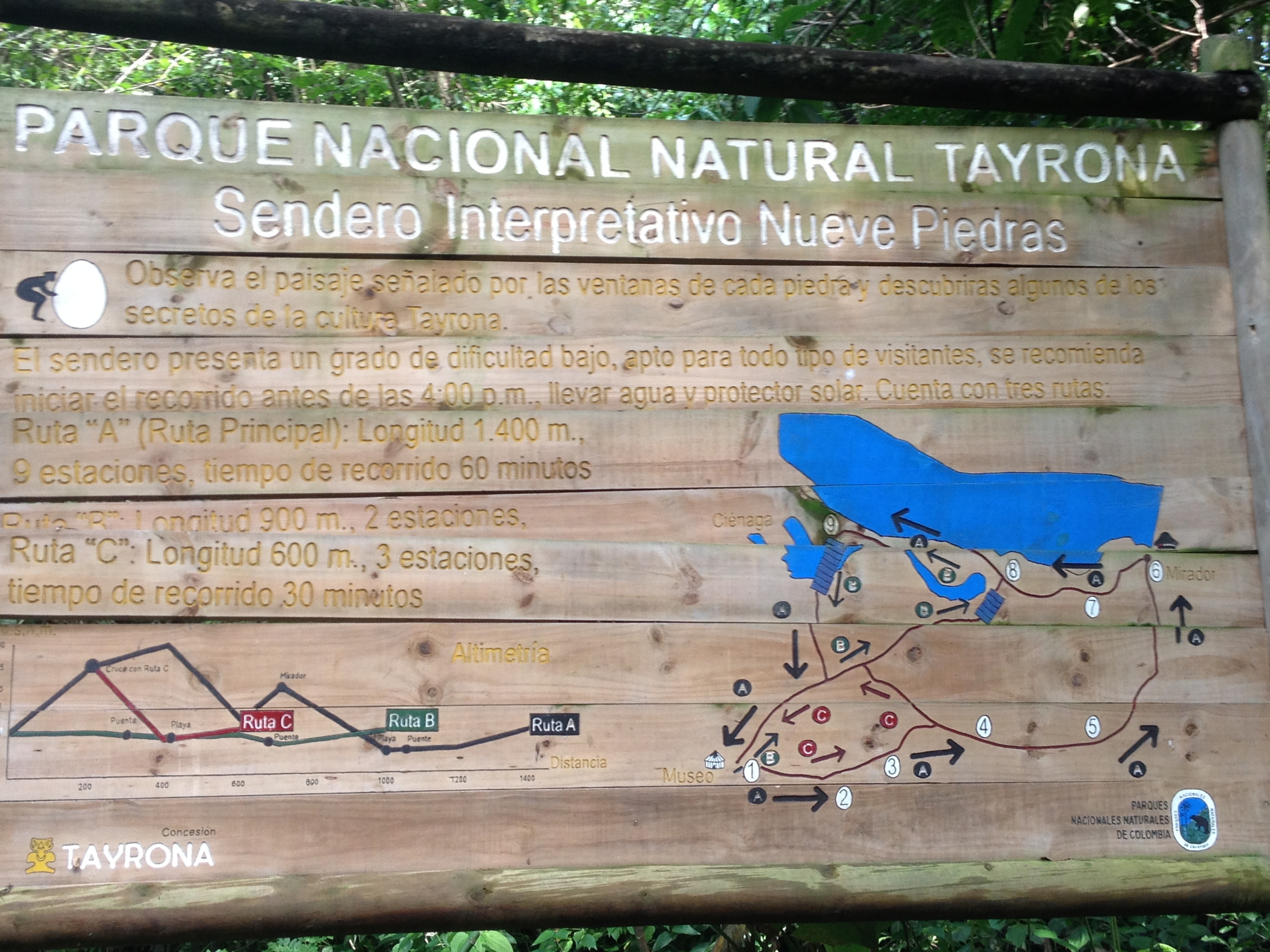
At the entry, where you pay the exorbitant $37.500 COL ($20USD) entrance fee  – the price of being an extranjero) – you leave an emergency phone number with the guard. “In case something happens,” he says, and then gives you a ‘tour’ of the park map, carved in wood on the side of an entrance hut, and some admonishments. “Only on a marked path….Only Sendero Arrecifes” he tells me, because that’s where I’ve said I’m going. Only since he tells you you can’t swim there, you’re going to La Piscina, a bit farther down the way. The guard seems doubtful you can do this and make it back in a day.

image

Wherever the trail leads to the beach, large signs warn you not to swim. More than 100 people have been lost in the surf, they tell you. At Arrecifes, where you can rent a horse for the trip back, or spend the night, buy a drink, or a bag, or an ice-cream pop, the trail dead ends into a soup of mud and there is no choice but to hike along the beach. The path to the sand sports a sign that says 200 people have been lost at this beach. It is not suitable for swimming. And then this:

image

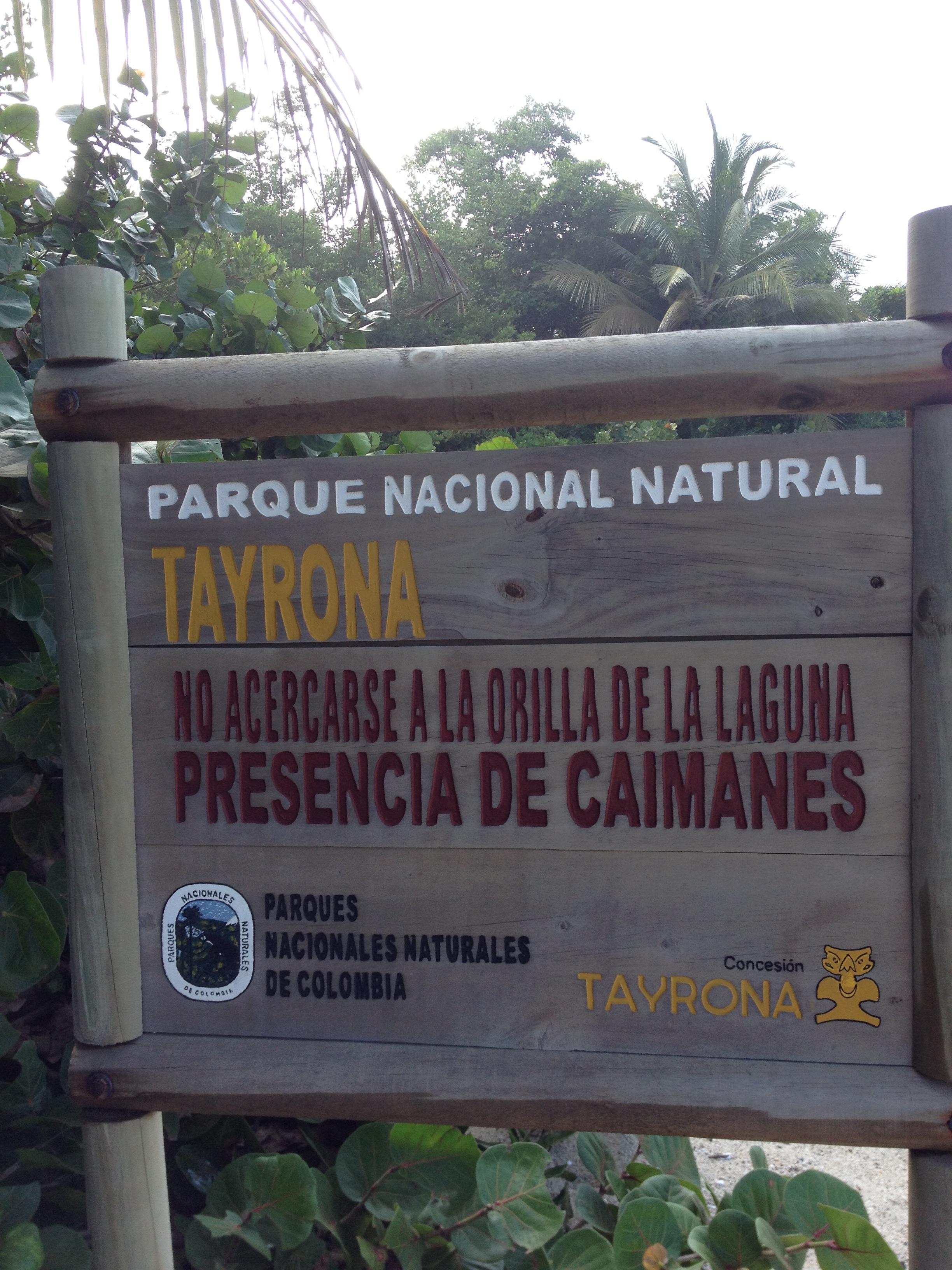
Your fearometer tells you that this says there have been caimans spotted in the lagoon, and not to swim in it. When the path actually turns to beach, there is another sign: 100 people have been lost here. You start to wonder if the caimans were responsible for 100 between the mud and the sand.

At La Piscina, the water is so warm it barely rinses off the sweat, and yet such sweet relief. First there is no one but you, and then, by twos, by fives, some hikers, a tour group, a family. The tide is coming in; you place your things on a high rock so as not to lose them. The jungle comes right down to the ocean here – the sand is being swallowed by the sea in this cove. Waves are full of bark bits and no one cares – you just want the pretense of cooling off.

On the way home, everyone walks the other way. They are coming to spend the night in a hammock between the jungle and the sea. One night, three nights. Couples looking for a private moment, backpackers on a cheap adventure, families who want to experience this national treasure. You can’t help but wonder if their kids will be whining from heat or boredom before night falls. You walk against this tide, think you could have spent the night with a group – but not alone. Not alerting to every sound – in the jungle, that makes for a long, long night. But to sleep by the sound of the sea, the occasional smell of salt in the air– it sounds sweet, it sounds like home. Next time, you think, already planning the return.

The ants go marching….

Moving, South America, Traveling, Uncategorized

How It Happens

This is how it happens, then. Slowly, almost imperceptibly, things fall into place.

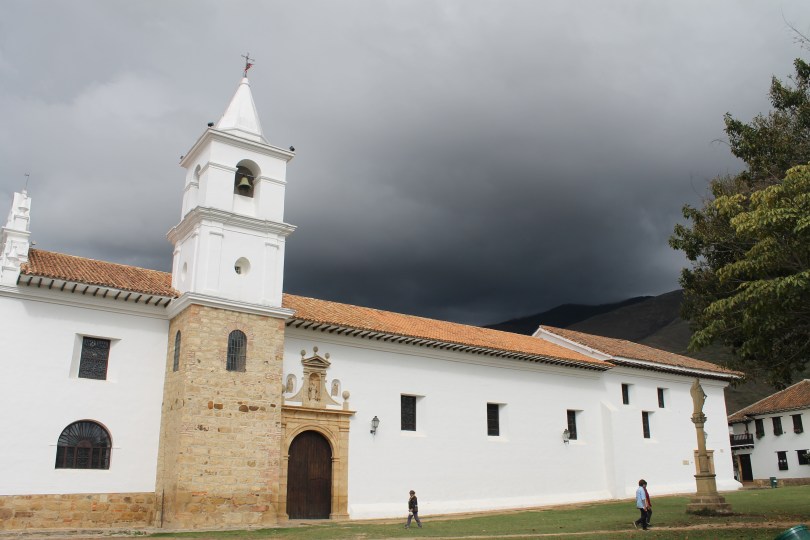
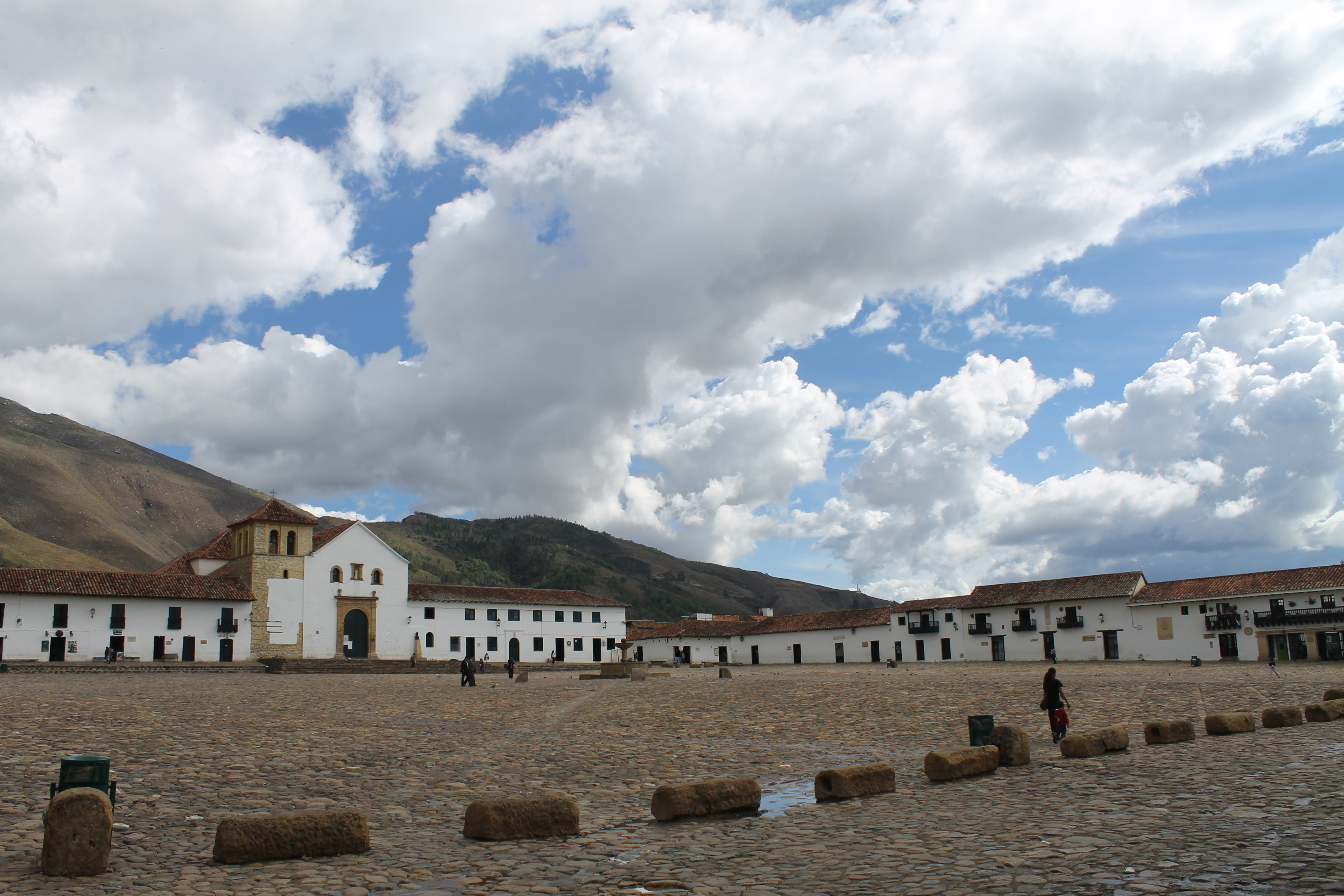
La Plaza de Villa de Leyva

La Plaza de Villa de Leyva

You leave the city for a smaller town. You ride the bus, watch the countryside change. You walk around, find a park, watch a family playing basketball in the twilight. Multiple generations – the girls mostly, their father, mother, and grandmother. You head to the plaza, buy a latte, and sit on the steps of the  church while evening services sing out the door. You watch a procession carry the virgin around the plaza, down a street. She doesn’t come back until the next day.

While sightseeing, you get caught in the downpour and don’t mind. You run into the owner of the comedor where you failed to consume the menu del dia because you couldn’t make the food go down the tunnel of knotted nerves that used to connect to your stomach.  She comments that you are wet, you’ve been caught in the rain. She invites you back for another try. You have just the soup, this time, so you don’t waste food.  And it’s perfect. Fresh, warm, filling. Your appetite has returned. When you pay, she lets you know the next day’s menu, so you can plan ahead.

Outside, the workmen leveling the cobblestone street – by hand, digging up the stones and rearranging them in a less treacherous fashion – are back to work. As you walk by, one raises his pick jokingly, as if to hit his coworker on the head. You notice and you laugh out loud, which makes all of them laugh with you.

This dude did NOT like when I got too close to one of his ladies

This dude did NOT like when I got too close to one of his ladies

You don’t care that you walk all the way to the ostrich farm and find it closed. Instead, you take a picture of a cow, and an oriole, and talk to a guy who’s twenty feet up a telephone pole hanging wire. You don’t mind when you find a little scorpion in the bathroom; you just put on your flip flops and do some thinking. You take a nap and listen to the second rainstorm of the day. After, a woman scrubs water down a large street with a very small broom.

in case there was ANY question...

In case there was ANY question…

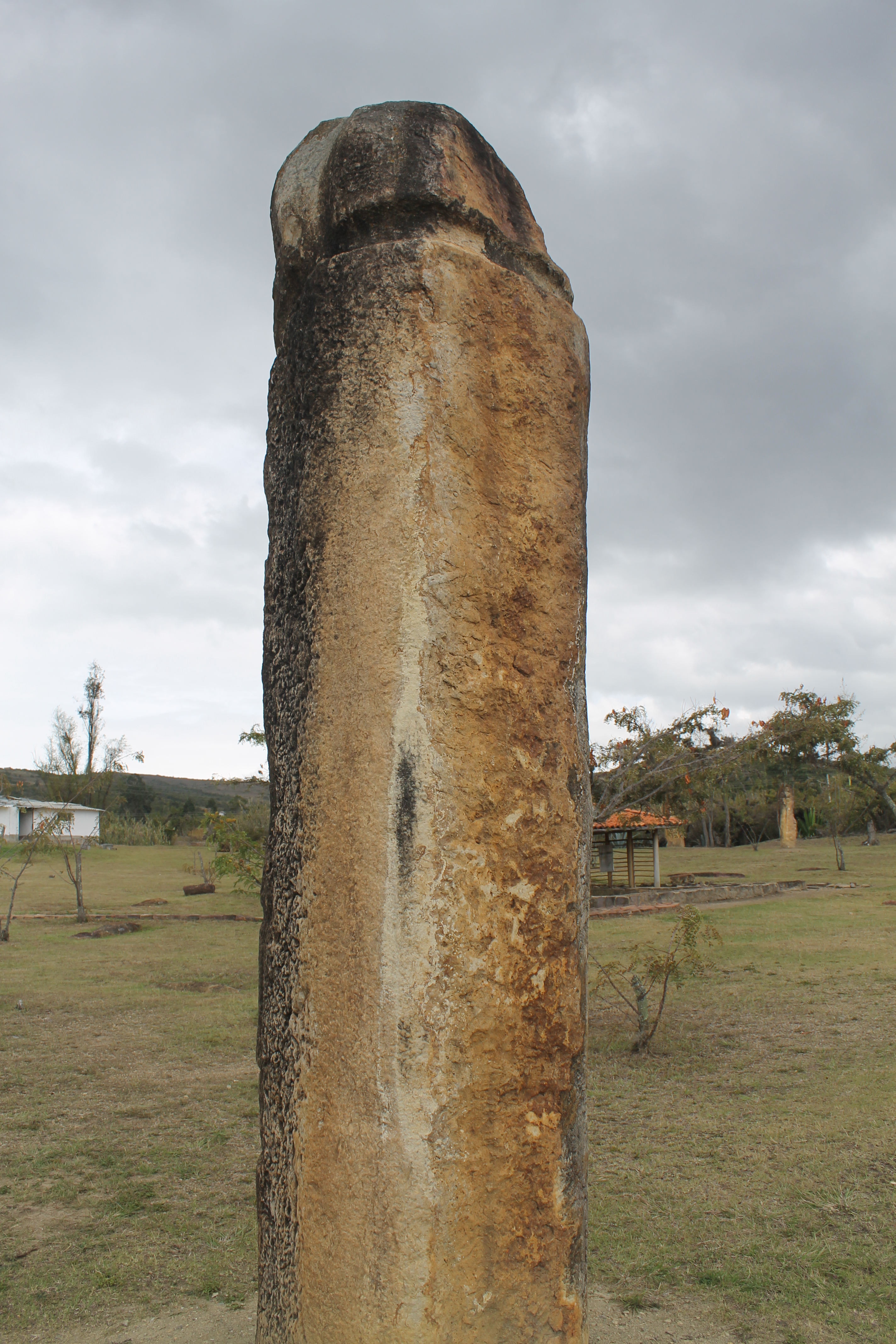
You see some fossils. The town is small enough that you run into everyone again – the lunch lady, the coffee lady, the guy you asked for directions – and they all want to know how the fossils were. They want to know If you liked the ancient stone structure like Stonehenge (only not, only smaller, only tiny and completely phallic – so how do you tell them you thought it was great without sounding like a perv?) and if you’re coming by later, for coffee, for lunch.

When you return to the Bogota, the city is more familiar. You get off at the right bus stop. You see landmarks where you change to the express. You sit through rush hour and laugh with the woman next to you when everyone, already packed like sardines, gets pushed a little more in places that aren’t pushable. What else is there to do?

This is how it happens, then. How the unfamiliar becomes familiar. How the nerves recede, for now. How you let the world in.

To see more pictures of my travels in Colombia, click here

On the Road, Tourist, Traveling, Uncategorized, United States

Heaven on Earth

I’ve been thinking about heaven a lot lately, driving around the United States and finding myself fully realizing the words to ‘America, the Beautiful,’ as amber waves of grain roll by my car windows. I’ve fallen into describing the awe-inspiring landscape as “heavenly,” meaning it brings peace, visual pleasure, and possibility into my frame of visual reference, and thought. In hotels, I’ve slept on more than one ‘heavenly bed,’ some because they are branded that way, and others because they bring the possibility of sleep and the chance to unbend my frame from it’s too-frequently seated position.  And from airplanes, of course, I’ve looked down at an ocean of puffy white cotton-like clouds outside the window and thought, ‘this is what they say heaven looks like.’ Yet upon my return to Orcas (the island I’ve made home base this fall) after a few weeks away, it occurred to me that if there is a heaven on earth, it is not a place or a vision, but a smell.

Sometimes heaven smells like wet seaweed

Sometimes heaven smells like wet seaweed

Smell transcends time and place. It can carry you from where you are now to where you were when. Think about it: the smell of fresh-baked cookies – anywhere – in a home or a bakery or wafting down a street in any small town or large metropolis – any where  in the world, can pull you from the moment you are in, to another moment, possibly long ago and far away, that is anchored by the smell of warm chocolate chips and dough that sinks back to hug them as they cool on a rack, and defined by the moment of peace or hope that it brought to you back in that time and space. Isn’t that what heaven is? The transcendence of the present to a larger realm of peace and possibility?

Sometimes heaven smells like fall

Sometimes heaven smells like fall

I am a person of place. I always have been.  I engage in a place by falling in love with its landscape. When I lived on the east coast, I often longed for the west coast with its cold ocean and high foothills. I longed for the hilly streets and old Victorians of San Francisco. I longed for the stillness of this island on which I’ve spent much of the last two months, and for the serenity of the view from where I now sit – over the grass, beyond the apple trees to the sound, to Lopez Island, to the sky above it and the Olympic mountains standing guard behind. For most of my life, I have associated this anchoring, this peace, with this place. I believed, for much of  my time living in Dallas, that what made it difficult was that city had no hills, not enough trees, too much strip mall cement.

And then a week ago, I drove off the ferry, cracked my window, and was in my heavenly home. The smell of clean air, laced with sea salt and rained grass, rushed in to welcome me.  In the distance was a top-note of wood-stove burning off fall chill and deep, deep beneath it were undertones reminiscent of the sun warming sugar out of last summer’s blackberries.

Suddenly, all the smells came to me. It wasn’t San Francisco I missed when I was on the East Coast. It was the smell of old book stores filled with history and revolution. It was salt floating on fog on early mornings when I waited for the bus to work. It was eucalyptus  trees carrying their native Australia to Tennessee Valley. Strip malls weren’t the problem with Dallas. The air was. Except when it was raining, and the air was filled with the electricity of a storm, Dallas atmosphere stagnated. There was no news being brought on the wind. You couldn’t tell where the ocean was by inhaling. There was no possibility blowing through.

And so, as I prepare to leave for lands that smell of dewy mornings in thin air, of the dirt road beneath your feet, the slow burn of trash in a neighboring field, the diesel of combis and collectivos that roar by, I’m taking some time to absorb this heaven. Lying in bed last night with a rain pounding wind down through the alder and rushing the scent of leaves and water through the roof eaves to where I lay, I inhaled deeply and held my breath, absorbing just a little bit of heaven on earth to bring with me on the road.

Heaven is the smell of true north

Heaven is the smell of true north

On the Road, Tourist, Traveling, Uncategorized, United States

Wild. Wonderful. Wyoming

I’m a sucker for a diorama. Always have been. Maybe it was those sugar eggs we got at Easter with the little scenes inside, or an over-eager grade school homework project  that did it, I don’t know. Maybe I just like how life looks, all laid out for view in a tidy defined box. Whatever it is, it’s stuck with me. So when I pulled into the Southeast Welcome Center on I-25 outside Cheyenne, Wyoming and perused the brochures to see what might be found in Casper, where I was headed for the night, it is no surprise that the flyer for the Fort Caspar History Museum caught my eye.  And it didn’t disappoint.

Captain's letter awaits an envelope

Captain’s letter awaits an envelope

The museum is on the site of Fort Caspar, and the remaining buildings – officer’s quarters, the mess, the store and stables – have been restored and stocked and they sit away from the main museum site, so when you stand there, wind blowing up from the Platte, sun bearing down on an early fall day, squash ripening in the fort garden, you can *almost* sense what came before you, quiet, isolated. Blue coats, sabers, and captain’s hats adorn the bunks, checker and card games are laid out on communal tables next to tin mugs, ready for rowdy players and beer. A telegraph machine waits for news on a table in its own cabin. Off to the side, a Mormon Ferry buggy stands proud. Diorama, real-size.

Soldiers quarters in the mess

Soldiers quarters in the mess

Telegraph table.

Telegraph table

Inside the museum, the history of Wyoming has been lovingly recreated in one diorama after another. A display of stone tools through different eras of history outlines changes in the land and the people, new kinds of stone, new types of tools, arrival of Europeans. Around it, in wood and clay, miniature native Americans hunt mammoth, hunt buffalo, build teepees, fend off Europeans, and then attack them. Men and horses fall in gory fashion, red-painted blood oozing from their detailed clay bodies. It’s miniature America in all her glory.

Miniature America, in all her glory

Miniature America, in all her glory

Wyoming is full of little treasures like this: pieces of history that have been picked up, cleaned off, embellished and put on display. I skipped three other museums in Casper in favor of getting back on the road to Bozeman, and didn’t even touch on others that are sprinkled along drivable routes across the state. Maybe it’s the benefit of oil dollars, though neither Fort Caspar nor the Welcome Center itself (which had a historical display, including a dinosaur skeleton and a number of dioramas) glossed over the boom and bust effect of the industry, that fund all these little gems.

And what would be the point in hiding this ugly truth? You can see it in the life-sized diorama of scenery that is Wyoming itself as the land goes by. Towns like Story, Buffalo, and Bar Nunn pulling you off into the distance of gas-scarred hillsides. Mule deer and cattle graze side by side on rolling grass-spotted hills and mesas, hiding between rock skyscrapers, divided by snow fences, waiting for winter.

Wyoming rolling by

Wyoming rolling by

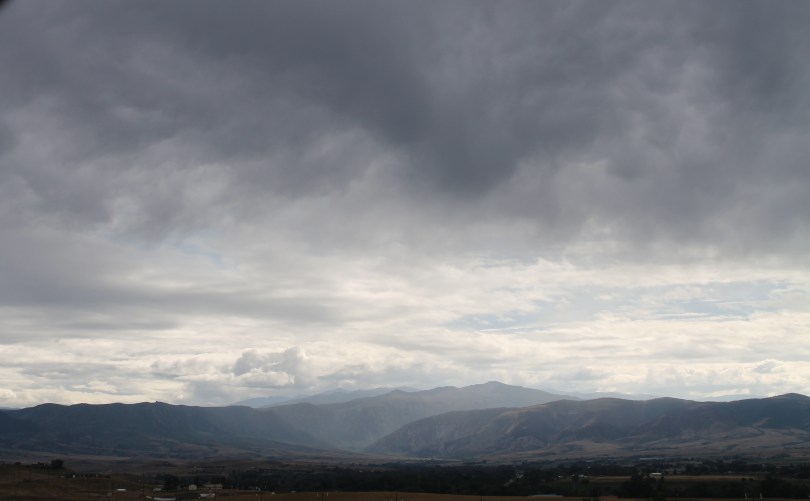
You feel the state in your bones as you drive it: riverbeds of cottonwoods changing colors and hardly another tree in sight except on the distant jagged mountains.  Red rock, granite, trains winding through. The Crazy Woman river running across it, running through you as you drive by. Wyoming. Wild. Windy. Wonderful Wyoming.

Sun after the rain on I-25

Sun after the rain on I-25

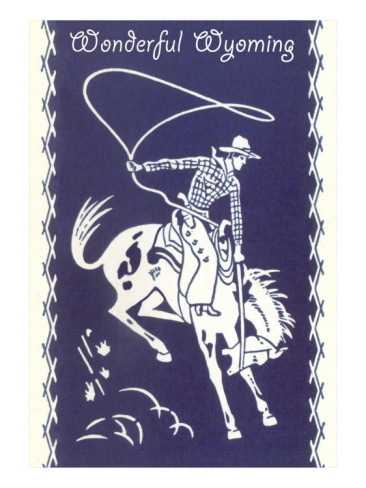
Wild. Wonderful. Wyoming.

Wild. Wonderful. Wyoming.