On the Road, Uncategorized

Are YOU My Cemetery?

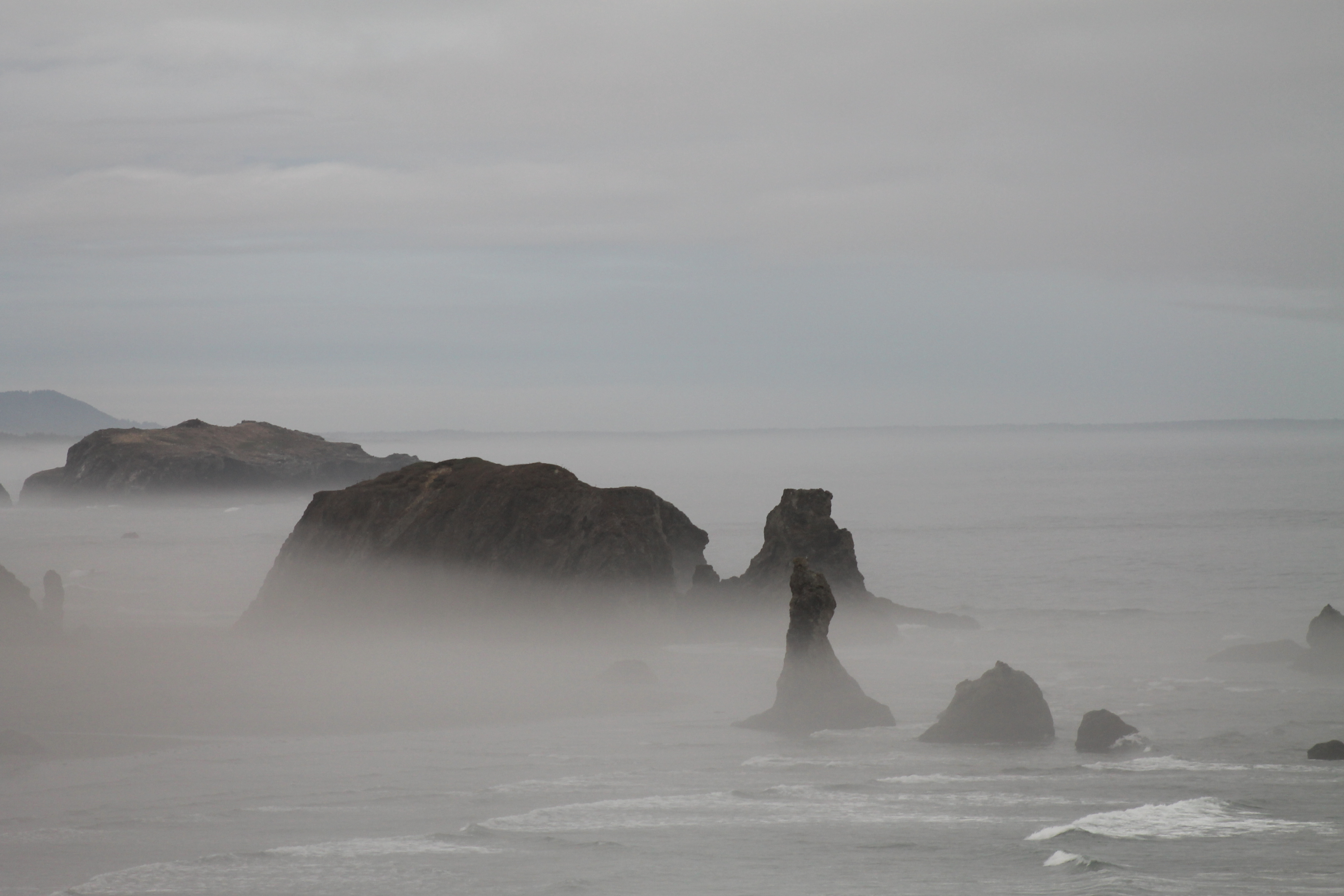
Sea Stacks in Bandon

I’m chasing my ancestors down the path of their history, backwards through the towns they settled along highway 42 in Oregon. The route wraps around the south side of the Coquille river, starting with the warm fog that twists its way around sea stacks in Bandon and heads into Pleasant Valley, where the sun blinks through overcast skies.

My goal is to visit the graves of my grandmother and her family before tearing north on I-5 to make the 9 pm ferry for the San Juan Islands. But a 20-year absence from this part of the country and a couple well-placed questions from my mother have got me reinventing that kids book I used to read in kindergarten, “Are You My Mother?” Instead of a bird asking every living animal or machine if I belong to it, I’m a human screeching off the highway every time I see a sign for a cemetery.

“Are YOU my cemetery,” I asked this morning, after taking a hard left and tiptoeing through the remains of Coquille, to arrive at the Masonic Cemetery. Coquille’s main street looks like a movie set – a stately bank, sculpted storefronts, and too many empty windows in front of which few people move.  The cemetery is so small and non-descript I couldn’t believe the Masons claim it. I u-turned illegally in front of the high school marquee announcing registration dates and head back to 42, conspicuous in my dirty black foreign wagon with the Texas plates.

“Are YOU my cemetery,” I asked again, outside Coquille, when a cemetery sign pointed up a small hill to the Myrtle Crest Memorial Gardens. The hill and quiet atmosphere were promising, but the cemetery was new and compact, one small loop of road with grave markers on either side, and four groundsmen tending to the sprinkler system. One moved his truck out of the one lane so I could get by without running over the dead, and while I headed back down the hill I thought it must be true what they say: the only two things you can count on are death and taxes, and the death part is an increasing certainty in this part of the country, where the land is what you count on, and there isn’t much else.

View of Pleasant Valley from Norway Cemetery

In my memory, at least, MY cemetery sits high on a hill with a view of the valley and a two lane road winding beneath it. There are pine trees, and graves from the last century, and an A&W not far down the road. I remember thinking the last time I was here that this wouldn’t be such a bad place to spend eternity. But things have changed. The winding two lane road is now a six lane arterial, and the town of Norway, which I believe is where MY cemetery is located, doesn’t show up on my iphone map. Still, the road winds on. To the left, hills rise and fall, and to the right, the valley lies down, throwing up a lumber mill, new or abandoned, or a dairy farm, from time to time.
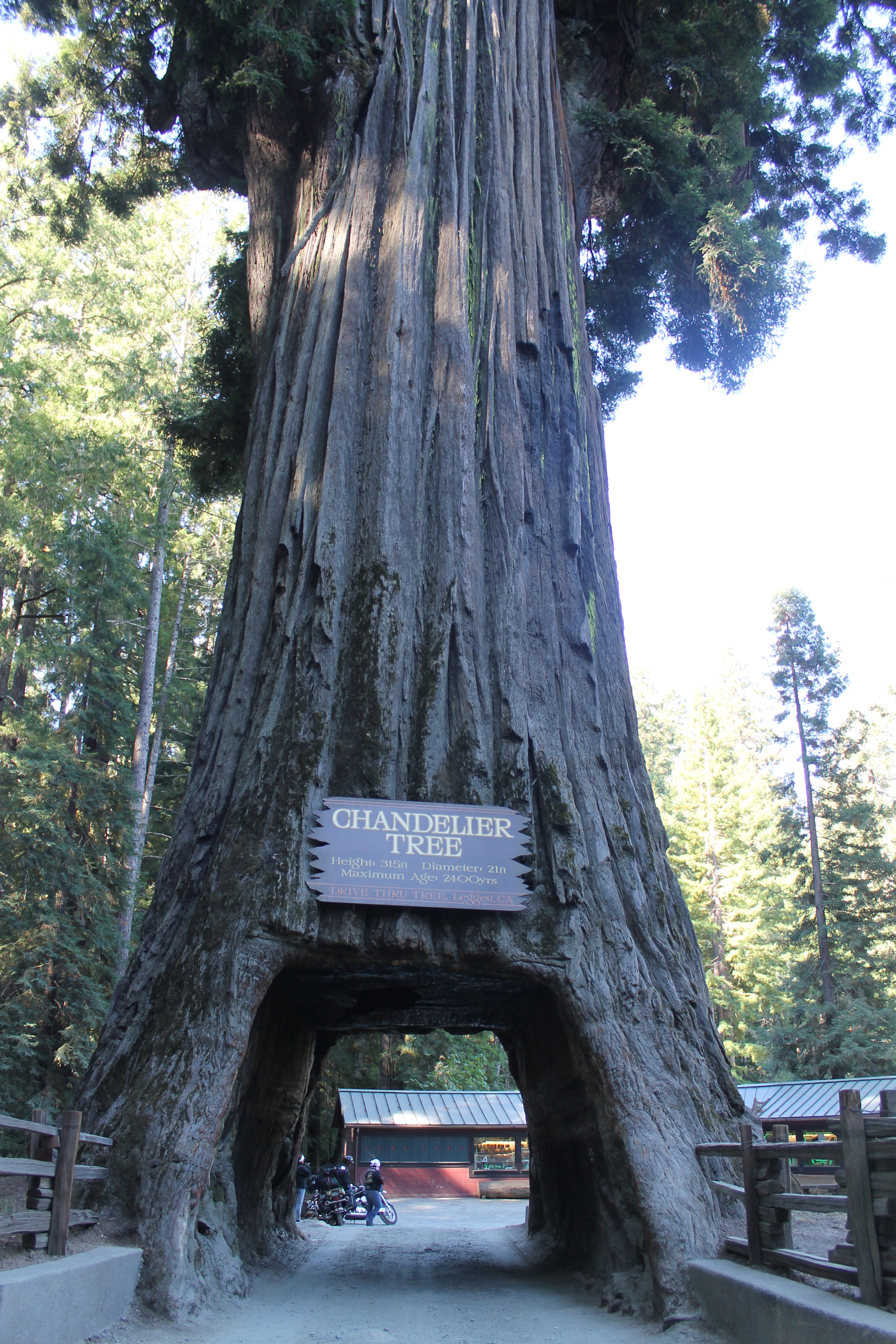
The Chandlier Drive-Thru Tree

They know what they are doing here, and they’ve been doing it for more than a century. Sheep and cattle graze the flat lands, timber is cultivated and felled on the mountains, and milled beside the busier transport roads. Always, trees are left bundled and tall along the most visible pathways, as if the pine curtain can hide a naked mountain of clear cut, or the low bush where trees begin to grow back, only to be cut again in how many years? 40? 50? Nothing will replace those that came down a century ago – like the ones along the Avenue of the Giants I drove yesterday on my way up California. There are no more “Drive Thru Trees” being grown, no more “One Log House.”
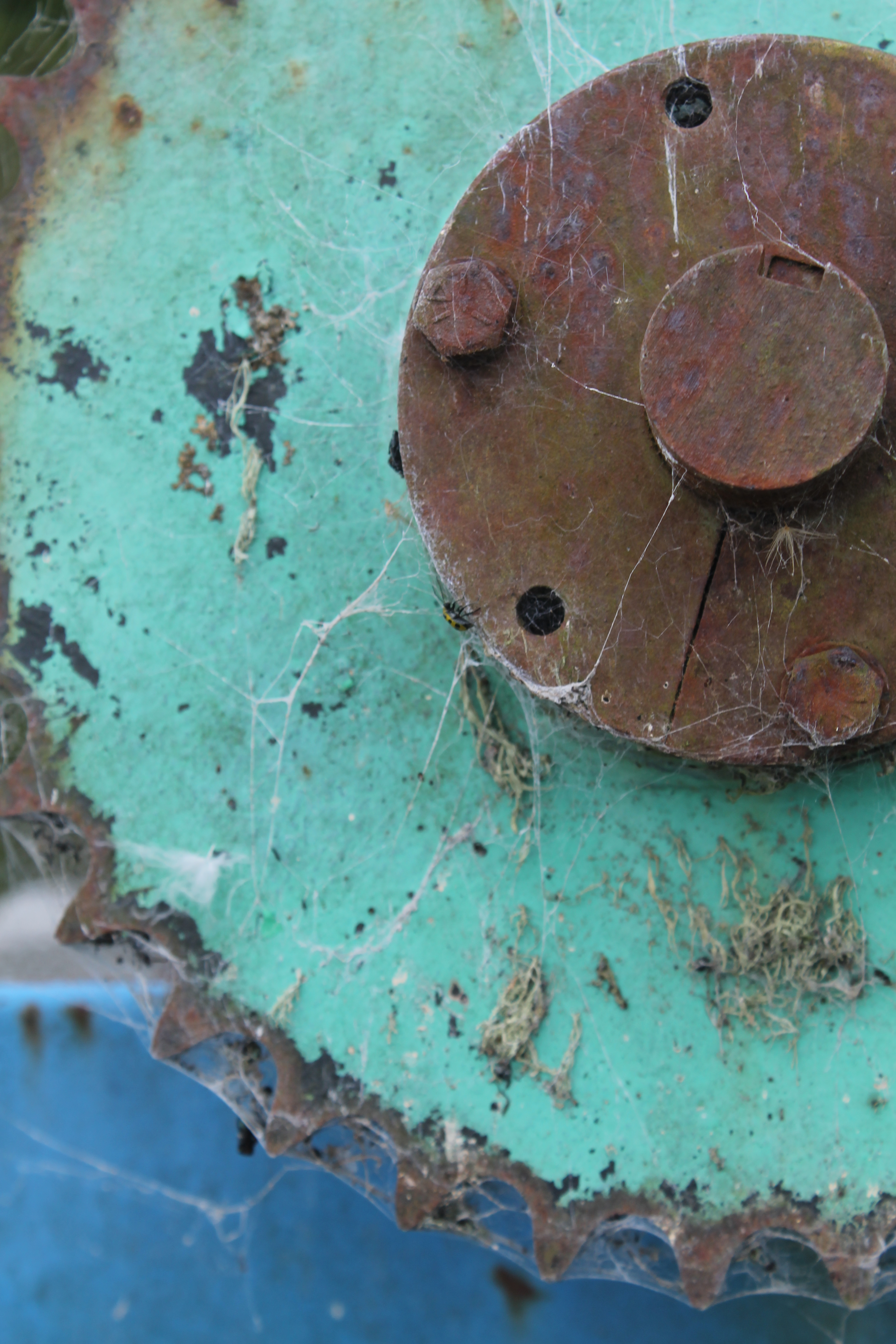
Mechanical memories of yesteryear

Mechanical memories of yesteryear

While I am gaping yet again at a truck cab speeding past, hauling his own back half on his mid section, the empty hitch and fork of a logging truck without the load, I see another cemetery sign out the corner of my right eye. As it registers, the turn-off passes on the left, blurred by the roadside leftovers dancing in the wake of the Mac cab. I take the next opportunity to pull off the main drag and circle back on old 42, slow, narrow, littered with mechanical memories of yesteryear. This is the southern Oregon I remember. This is my America.
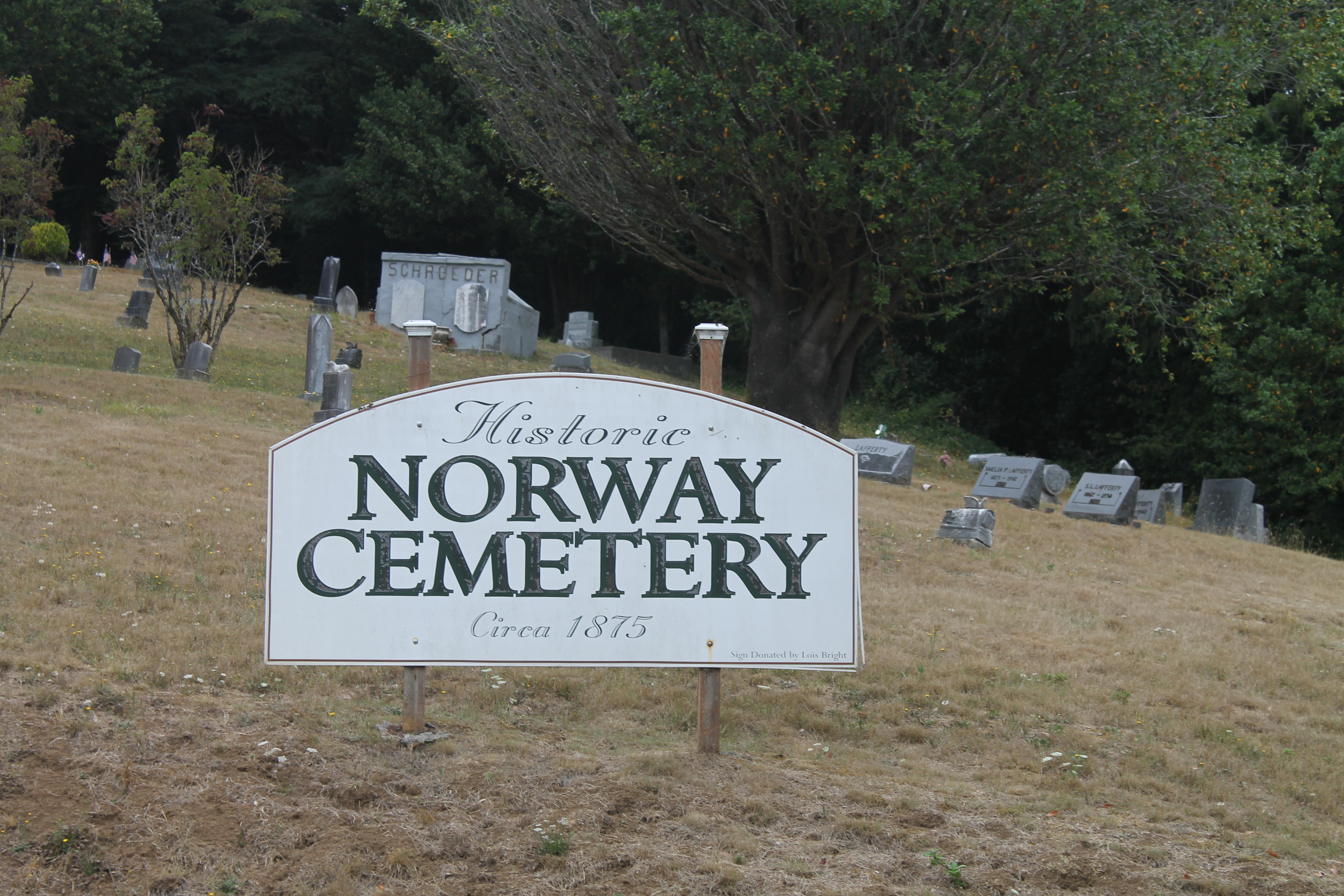
Welcome to Norway Cemetery

I miss twice before making the turn. The new road is up ten feet higher than the old one. To get up the cemetery hill, you must first go down into a rut. “Historic Norway Cemetery,” the sign welcomes. Then validates, “circa 1875.” My grandmother and great aunts, their parents and aunts and uncles are where they were left.  The view is little changed, though the trees slightly overgrown. A lone gardener tends to some of the grave sites.

I sit with my family, have my communion with the dead. The dog chooses my great-great uncle’s stone as a cool place to lay his head on a heating day. I update everyone on my sisters, my niece and nephews, who looks like whom and acts like who else. I sit in silence and look at the valley, then wander around the gravesites of pioneers. And then I head out, communion finished, twist back down  to the new 42, and speed past the A&W to head north.
IMG_3039

On the Road, Tourist, Traveling

Walnut Canyon

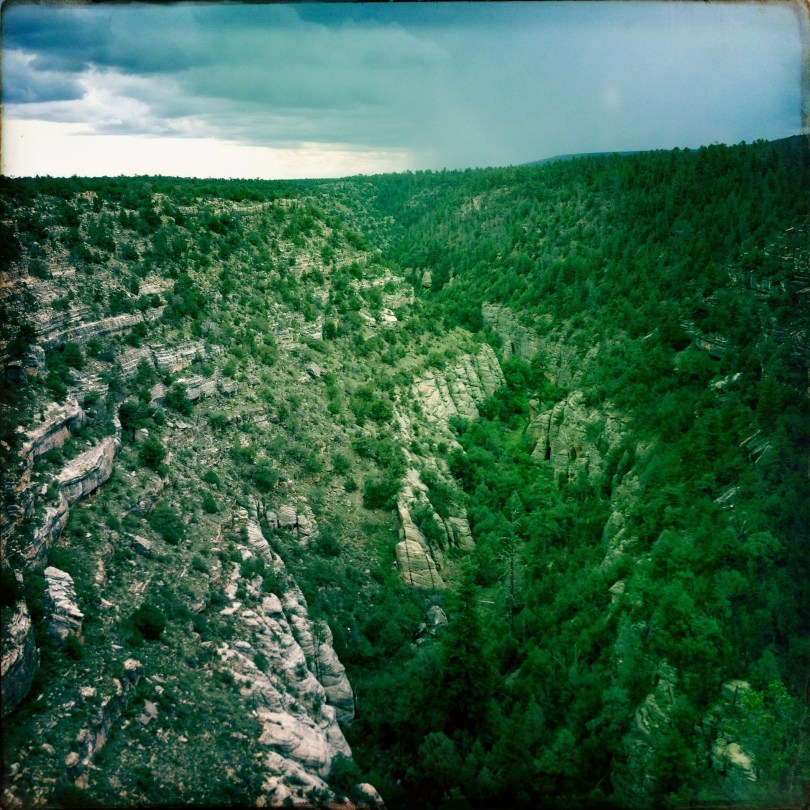
IMG_2397It looks like nothing coming in: a highway exit outside of Flagstaff, a quick sharp turn and the road becomes small, quiet. High, arid mountain scenery. Smell of rain coming in. You get out of your car, walk to the edge, and it falls before you:  a  canyon of dripping limestone and piñon, layers of rock and earth weathered by wind and rain, striated by history.

Look  a little closer. You’ll see what they saw, the Sinagua, who lived here for more than a century, over seven centuries ago. You’ll see crevices that could become home, protect you from wind, hold the heat of a hearth fire. You’ll see the river water below, dirt that could become clay, that could become bricks to build houses in the high-walled world. The view of the eagles, to keep watch. Plant life so diverse it is unrivaled elsewhere in the valley.  And so you build.

IMG_2315Down the 185 steps from the ranger station, the canyon is so quiet you can hear a child sigh from the far end of the trail. You can hear your own breath as it stumbles from your lungs, unaccustomed to the 6,700-foot elevation. You can smell, on the warm wind, the black walnut in the creek bed below, and when you look down to find the source, you’ll find instead a hawk, lumbering below you, working his way up on the current, until he soars above your head, and still beneath the canyon ceiling.

You can duck into the empty houses tucked into the wall and stare at the residue of hearthfire smoke on the ceiling, and wonder what it was like to live here. And while tucked in this studio apartment that used to house a family, you’ll look across the canyon and realize those striations you see in the rock, half of them are filled with homes just like this one, scattered across the area. If there were still families here, you could holler to your cross-canyon neighbor to borrow a cup of sugar.

crop flowerNo one really knows what caused the Sinagua to homestead in Walnut Canyon, or why they left.  The name itself is a misnomer:  these are native peoples, not speakers of Spanish. Here, just as at Montezuma’s Castle and Tuzigoot, the settlements aren’t far from water. Though climbing more than thirty stories of steps to carry it isn’t ideal, the safety gained from living in an almost imperceptible hole in a rock is worth the effort.

Sinagua settlements up and down the Verde Valley, now mapped by Arizona Highway 17 running south from Flagstaff to Phoenix, all share this same mysterious fate: their development appears at various times, and then they are deserted. Some groups, like those at Montezuma’s Castle, stayed more than four hundred years. Others didn’t last.  Around 1250 AD, after less than 200 years of habitation, Walnut Canyon was abandoned, leaving behind evidence of ample, healthy trade with people as far away as Central America, but no reason for departure. Hopi legend claims the Sinagua as an origin people of their own. Other theories say the Yavapai came and pushed out the Sinagua. Whatever the reason, they left , gifting us this trove of historic mystery in their wake.

IMG_2326

For more images of Walnut Canyon and Montezuma’s Castle, please visit the Ruins of the Southwest Gallery.

Life Skills, Moving, On the Road, Tourist, Traveling

Leap of Faith

A guy should really buy you a stiff drink before he pulls you onto his lap and straps on a harness.

That’s what I’m thinking a few minutes before jumping out of a perfectly good plane. I don’t say it, because let’s face it, though I may have four points of 1500-pound web and metal connection to Tyler, the instructor,  I don’t really know him well enough to be quite that…forward. Despite the fact that I am also sitting on his lap, and in addition to my ass, my life is in his hands.

Moments later he leans forward, taps the pilot on the shoulder, and hollers into my ear, “you ready?”

Fear has prevented me from changing the expression on my face from the frozen smile I had when we took off, so I nod.  At this point, I’ve made the live-or-die decision to go ahead with this business. Matters are really out of my hands on the whole ‘parachute opening’ thing. Now, I’m worried about puking during the jump, which would be fine for me because I’m wearing goggles, and on the bottom, but I’m sure that wouldn’t work out well for Tyler.

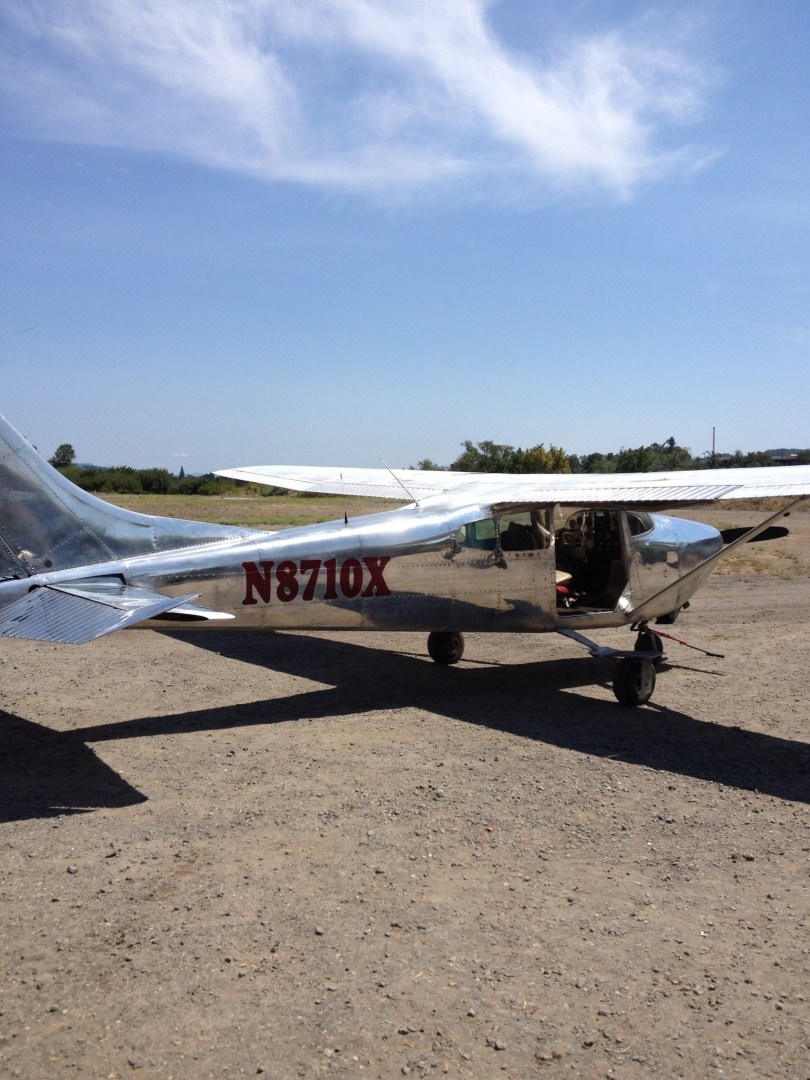
Things you don’t think about in advance: of course the plane door opens upward, like on a DeLorean. Otherwise, in 120 knots-per-hour it would come smashing back on my legs, which are now dangling out the hole in the plane’s hull. I’m trying to rest them, ladylike, on the step above the landing gear, but they are just blowing to the side, so I leave it be.

“Chest out,” Tyler says into my ear. “Lean forward,” almost like he’s teaching me to dive. And just like learning to dive, the anticipation is the worst part. With a little lean and a slight push, we’re gone.

There is a moment of tumble, of inertia and movement, and then there: below me is a postcard of wine country. It’s chilly and windy. My mouth is open; when I gave velocity a smirk, it took a gaping grin and pulled all the moisture from my tongue and teeth. I kick my legs out behind me, trying to hit Tyler in the butt just like I was instructed, and let my arms fly out  at my sides. The fall is free and gleeful, and loud with the rush of sky blowing past my ears. You can’t help but yelp, or yip, or yahoo, and so I do. Freely, and gleefully. The fear is left back on the plane with the pilot, coming in for a safe landing on the little air strip far below us.

Then Tyler taps my shoulder again, and again asks, “you ready?” and with that, there is a tug. I hear a flap of fabric against the wind, the sound of a luffing sail, and then the chute snaps taut above us and things become quiet. The vineyards line up below for inspection, organizing the hills into orderly view. Tuscan mansions, wine valley bungalows, trailers and the makeshift labor camps of early pickers speckle the landscape.

Tyler gives me a choice between being still and doing some loops and turns. “Loops and turns,” I shout back in the wind. “Loops and turns!” After two turns, I shout again, “actually, no loops and turns!” I (or more like Tyler) narrowly escape the puking scenario and we return to our graceful float, featherlike. We watch the earth rise to meet us for a five-minute eternity. And then, “lift your feet in front of you,” and here the ground is, right in front of the hangar from which we took off, landing pad of a lifetime, and we walk right in.

Tyler and I, right after walking right back down to the ground

Tyler and I, right after walking right back down to the ground

Moving, On the Road, Preparing, Traveling, Uncategorized

Goodbye to Good Gear

Good gear is essential  to a good trip. Unlike the life-or-death technical difference that defines good gear for, say, an Everest climber, for a traveler, 80% of the “good” in gear is born of the relationship you build with it over time.

For years, I traveled everywhere with an Eagle Creek shoulder bag that perfectly held a journal, guidebook, waterbottle and camera. It came with me to Korea, China, Italy. Somewhere in India, its zipper gave out, so I sent it back to Eagle Creek, who kindly fixed it for free, and I used it again – Guatemala, Nicaragua – until the waterproof lining began to peel off, the canvas weakened, and I had to give it up. The bag, which I still refuse to throw out, had reached its bitter, beloved end.

Good Gear Gone

Good Gear Gone

So I should have been prepared for what happened my first week on the road. To minimize what I lugged in and out of one-night stays, I packed my road clothes in a small, black Eddie Bauer duffle bag I bought circa 1998. To differentiate it from the crowd at baggage claim, I tied a white polka-dotted ribbon to the haul-strap on one end. It perfectly fits ten days worth of clothes, two books and toiletries for the road.

My first night in Taos, I pulled out my pjs and saw trouble. The black tank top in which I sleep looked as if it had developed dandruff on our 13 hour drive.

Duffle Dandruff

Duffle Dandruff

My jeans seemed to have lice. Had a spider hatched eggs in there? One item after another came out of the bag with the tell-tale signs of water-resistant lining peeling off the canvas like skin after a sunburn.  For four days, I wore my clothes in shame, and mourned the imminent death of this good gear.

By Santa Fe, I was consciously suppressing the urge to tell complete strangers, “I don’t have lice – it’s just my bag.” Something had to be done. I bucked up and headed to REI to buy a duffle, aiming to spend no more than $40. I had to dig – through aisles of backpacks with padded straps and toggled bungees that hold gear, through beautiful Eagle Creek duffles with hard bases and rolling wheels. At last I found a multi-colored, slightly retro canvas bag for $49. Longer than my old one, and rounder, its zipper didn’t quite run the length of the top. There could be an uncomfortable reach to pack-in and grab-out, but it would do..

There is nothing to say about this bag other than it just didn’t feel right. It wasn’t mine. It had to go back – but not before I found the proper alternative. So I headed to Alpine Sports, a small, independent store four blocks off the Santa Fe plaza that has been the solution to many a traveler’s clothing dilemma (including my own).  I walked in and asked about duffle bags, and there I fell in love.

I don’t know the name of the man who helped me. I can’t remember it – though I do remember he was the divorced dad of two-and-a-half year old twins. I just know that when he said, “all we have are those,” and pointed to a wall display of brightly-colored, sealant-immersed duffle bags with backpack straps and multi-colored zippers, it was as if the heavens opened and parted the Red Sea holding closed my wallet.

My Patagonia Love Affair

My Patagonia Love Affair

“But they’re Patagonia,” he said, knowing I wanted to spend under $50. I looked anyway. How could I not? I unzipped and re-zipped the pockets. I pulled out the display stuffing to discover a bright green lining inside. I checked the price, caught my breath, and listened as the clerk reminded me that if I bought one of these, I better like it because I wouldn’t need a new one for another decade. And then I went to have lunch.

While sitting at the Cowgirl BBQ, enjoying a harvest salad and Arnold Palmer with Spanky at my feet, I texted my better shopping advisors for advice. Before one could respond with, “do it, girl!” and another could forward the link for the Patagonia ambassadors page, I already knew what I would do. When you’re in love, you’re in love. No regrets.

Dallas, Goodbye, Life Skills, Moving, On the Road, Preparing, Tourist, Traveling

Dallas in My Rearview Mirror

Tomorrow, I will pack my car and watch Dallas fade in my rearview mirror for the last time as a resident. As excited as I am about the beginnings this end represents, I find myself more mixed than I expected about the ‘no-mores’ and ‘haven’t-yets’ that come with it.

Foggy Day in Dallas

Foggy Day in Dallas

This isn’t an ‘I left my heart in San Francisco,’ kind of moment; Dallas and I have never had that kind of relationship. I came for a job and brought an attitude with me, assuming I’d be here two years, and leave. I never actually checked in, so I’m not sure you could call my approach checked-out. But it definitely was disengaged.

My sweet hundred-year-old home in a rare snowfall

And then a few things happened that kept me here. I liked my job. I could afford to buy a house on my own.I fell in love with the house – and then with the convenience of living in Dallas. I ignored that part of me that wasn’t actually doing any actual ‘living’ – an ignorance that is easy to come by when you do yard work, house work, and burglary prevention, get a dog to play with, and watch too much t.v.

After years of returning to San Francisco and Seattle on vacation and wondering how to respond to questions like, “when are you going to get out of there,” I started getting defensive. “It’s not so bad. It has it’s good points,” I’d respond. And then I’d try to list them, and realize my list was short. ‘No state income tax’ is a weak argument in Seattle, which also has no state income tax, in addition to Mount Baker, Mount Rainier, the San Juan Islands, the Olympic Peninsula, and public transportation that actually gets you somewhere. So I realized I needed to augment my list. I started getting engaged.

I actually liked what I found. Dallas has great music venues, many of them in cool old theaters with no such thing as a bad seat in the house. It has Big Tex, the Texas Star and a handful of good dive bars. In the last couple years, I’ve heard speakers from Junot Diaz to Madeline Albright, watched a taping of Wait Wait Don’t Tell Me, seen Hair, West Side Story, and Alvin Ailey (among others), and heard bands from Metric to Loretta Lynn. I’ve seen Gordon Parks and Cindy Sherman exhibits. I’ve watched the arts district grow by one theater, then another, then an amazing public park the draws people outside for food trucks and chess games and yoga class. And when I tire of Dallas, when I crave some lefty funk, I head to Fort Worth for an afternoon at the Amon Carter or a night at Billy Bob’s. My time is here is ending, but my opportunities to explore are far from over.

Relentless Reunion Tower

Relentless Reunion Tower

I haven’t yet made it to the Canton flea market, or another Chef DAT dinner. I haven’t learned to love the Cowboys, or even how to talk about football, no matter how good it may be for my social life or career. I haven’t learned to two-step, though I have the boots to do it. I haven’t yet eaten at Nazca, that new place at 75 and Walnut Hill – someone go and let me know how it is.

Despite all I haven’t done, my life here has much familiarity that I will miss: driving by the 1-2-3 Divorce storefront on Fitzhugh, which always makes me smile; brunch at la Duni; morning dog walks on Swiss Ave, watching old, neglected houses come back to life during a loving restoration. I’ll miss Taco Joint migas tacos to start the day. Pizza, wine and writing Wednesdays at Times Ten. Nights at the Granada, or the Kessler, falling in love with music I’ve never heard before, or moving on from music I thought I loved. I’ll miss frontage roads to anywhere, and valets to park you everywhere (actually, I won’t – I HATE valet). And of course, I will miss my friends.
In truth, what I will miss most about Dallas is the one thing so obvious to those who know me here, and so foreign to those who know me elsewhere. Even as a resident Dallas, I am an intellectual tourist. The joy, frustration, challenge, and growth that have come from being unable to assume the people around me, even close friends, agree with my outlook (political, social, economic, artistic, what-have-you), are unlike anything I have experienced in any of the other wonderful cities I’ve been lucky to call home. At home in Dallas, I travel regularly through a place so foreign, I could likely stay forever and never have it feel like home. And there is some benefit to that, as I’m sure I will find on the road.

IMG_1312